
A rigorous scientific discussion of a master
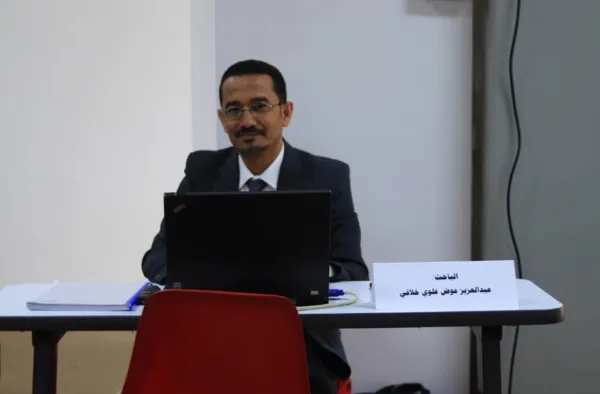
A rigorous scientific discussion of a master's thesis by Dr. Abdulaziz Al-Khalaqi, a faculty member at the university, on the effect of khat on digestive system hormones.
University Media
Sana'a University, Faculty of Medicine and Health Sciences - Department of Biochemistry, witnessed a distinguished public discussion of a master's thesis submitted by researcher Abdulaziz Awad Alawi Awad Al-Khalaqi, a faculty member and teaching assistant at the Faculty of Medicine and Health Sciences, as part of the requirements for obtaining a master's degree in Medical Biochemistry.
The thesis, entitled "Ghrelin and Gastrin Hormone Levels in the Serum of Yemeni Khat Chewers," sheds light on a health issue with societal dimensions. The precise scientific study aimed to measure the levels of the hormones ghrelin and gastrin in khat chewers and compare them to non-chewers, in addition to analyzing several blood indicators and lipids in blood serum.
This study aimed to measure the levels of the hormones ghrelin and gastrin in the serum of Yemeni khat chewers, compare ghrelin, gastrin, triglyceride, and cholesterol levels between khat chewers and non-chewers, and compare serum hematological parameters between the two groups.
The results showed a significant increase in serum gastrin levels in khat chewers three hours after chewing 300 grams compared to the control group (p=0.001), while triglycerides showed a significant decrease (p=3.4 × 10⁻⁷). An increase in the total white blood cell count (p=0.003) was also observed three hours after chewing compared to baseline values in the same group.
The study also revealed a positive correlation between ghrelin and age and cholesterol (0.00006, 0.011, respectively), and a negative correlation with hemoglobin levels (0.038).
The study concluded that khat chewers are more prone to elevated gastrin levels, which may lead to increased gastric acid secretion and, consequently, a higher risk of developing stomach ulcers, gastroesophageal reflux disease (GERD), and gastrointestinal bleeding.
The researcher recommended conducting future studies involving larger numbers of adult Yemeni men and women, along with expanding the study to include other gastrointestinal hormones, to complete the scientific picture of the physiological effects of khat chewing.
The thesis was supervised by: Prof. Dr. Waleed Ahmed Al-Daba’i (Principal Supervisor) and Assoc. Prof. Dr. Sadiq Saad Abdulmughni (Co-Supervisor).
The examining committee consisted of: Assoc. Prof. Dr. Abdulqawi Ali Al-Shamakh (Chair), Prof. Dr. Waleed Ahmed Al-Daba’i (Member), and Dr. Nawal Ahmed Al-Hanhana (Member).
On this occasion, the Emirates International University extends its warmest congratulations to Dr. Abdulaziz Al-Khulaqi on this outstanding scientific achievement, which reflects a spirit of rigorous research and responsible academic commitment.
The university affirms its ongoing commitment to developing its academic staff and supporting them in their scientific and research endeavors, believing that investing in talent is the cornerstone of enhancing the quality of higher education and serving the community with sound knowledge and purposeful scientific research.
This achievement represents a significant addition to the university's academic record and embodies its vision of building a qualified academic cadre that effectively contributes to the advancement of scientific research and addresses health issues relevant to Yemeni society.
https://www.facebook.com/share/p/18JcvrLMeJ/
#Emirates_International_University
#Emirates_International_University
#EIU