Smart leadership creates sustainability: A unique graduation project by students from the Department of International Business Administration
Smart Leadership Creates Sustainability: A Distinctive Graduation Project by Students from the Department of International Business Administration
University Media
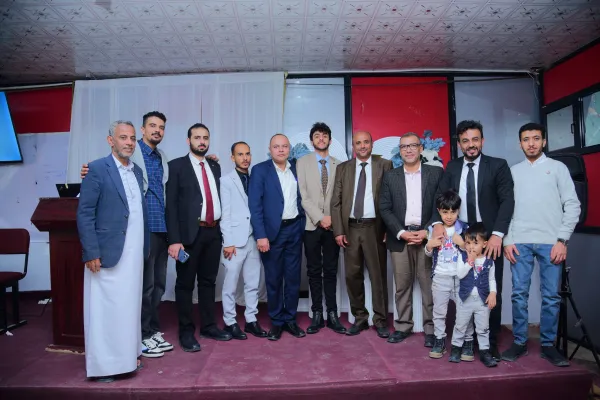
In a scholarly event reflecting the maturity of the educational experience and the quality of its outcomes, the College of Administrative and Financial Sciences at the Emirates International University today witnessed the discussion of a distinguished graduation project entitled: "The Impact of Smart Leadership on Achieving Organizational Sustainability – A Case Study of Yemen Soft Company." This project was undertaken as part of the requirements for obtaining a Bachelor's degree in International Business Administration (Arabic Section).
The project was the fruit of a collaborative scholarly effort by a group of students: Fahd Abdul Razzaq Abdul Rahim, Akram Al-Ashwal, Khalid Nabil Al-Sufyani, Osama Adel Al-Sharjabi, Anwar Ismail Hanash, Abdul Mughni Al-Ariqi, and Mohsen Al-Sabri, under the supervision of Dr. Mohammed Al-Kahali, Associate Professor of Business Administration and Dean of the College of Administrative and Financial Sciences.
This research addressed one of the most important modern management concepts: smart leadership and its dimensions (emotional, rational, spiritual, and digital), and its role in achieving organizational sustainability. This was done through an applied study on Yemen Soft, using a field sample of 130 individuals and employing advanced statistical analysis tools, most notably multiple regression analysis.
The study results showed a statistically significant impact of the combined dimensions of smart leadership on achieving organizational sustainability, with a high explanatory power of 66.5% for the model. This confirms that smart leadership is a fundamental pillar in supporting organizational sustainability and enhancing its long-term performance.
The results also revealed that emotional intelligence was the most influential dimension in achieving organizational sustainability, followed by rational intelligence, then spiritual intelligence. Digital intelligence, however, did not show a statistically significant impact within the overall model. The study confirmed strong correlations between smart leadership and the dimensions of sustainability (economic, social, and environmental), reflecting its pivotal role in establishing sustainable practices within organizations.
At the descriptive level, the results showed that the company's level of smart leadership practices was very high, with rational intelligence leading, followed by spiritual and then digital intelligence. Emotional intelligence came in last, although it remained at a high level. Organizational sustainability also scored highly, with the environmental dimension leading, followed by the economic and then the social.
The discussion committee consisted of Professor Dr. Mohammed Al-Kahali, Dr. Abdullah Al-Qurashi – Head of the Department of International Business Administration, and Professor Dr. Fahmi Al-Daqaf – Head of the Departments of Accounting and Financial and Banking Sciences. The committee commended the project's outstanding academic level, its rigorous methodological analysis, and the students' ability to connect theory with practical application in a way that serves the realities of the business environment.
This high-quality project reflects the academic excellence achieved by the Emirates International University and its commitment to preparing qualified graduates equipped with analytical thinking skills and strategic vision, capable of providing innovative scientific solutions that contribute to the development and sustainability of institutions.
This achievement also embodies one of the inspiring models of university education outcomes that the university relies on to build a conscious, leading generation equipped with the skills of the future, and capable of driving change towards sustainable development based on knowledge and innovation.
#EmiratesInternationalUniversity
#ModernityExcellence
#EIU